Sign in to edit
Anyone can edit Stonks — you just need an account so your work can be credited and an editor knows who to ask if there's a question. It takes one click with Discord.
Editing Stonks
Changes go to an editor for review before they appear. Nothing here is published directly.
Loading the current page…
Origin
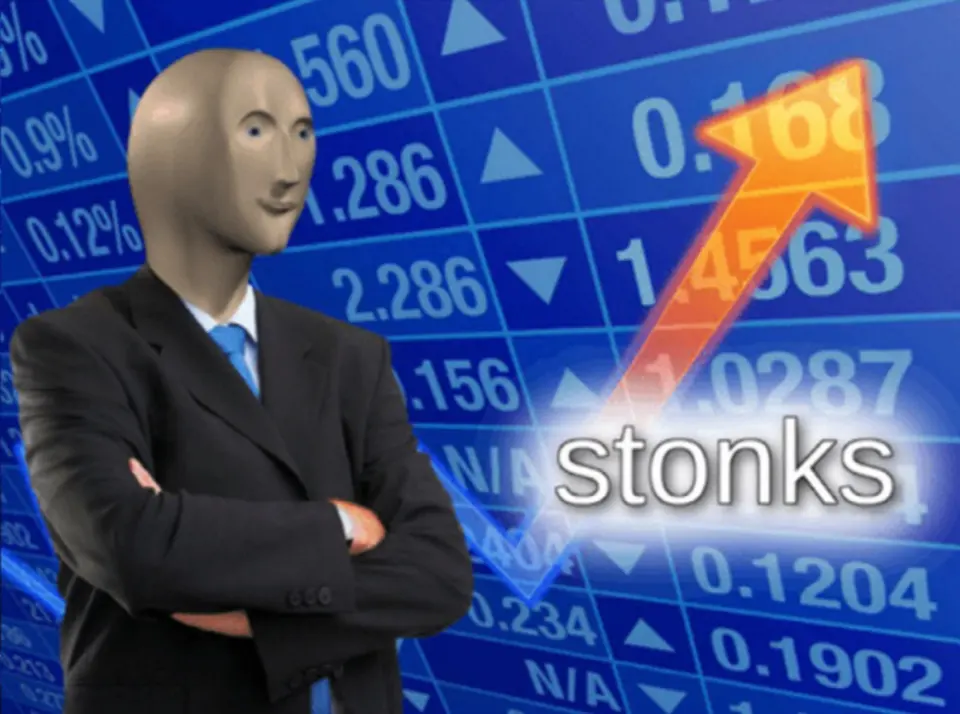
The image was posted by the Facebook page Special Meme Fresh on June 5, 2017: Meme Man — a featureless, low-poly 3D head — standing in front of a stock-market chart, over the single deliberately misspelled word “STONKS.” The original post took over 3,600 likes and reactions.
Meme Man belongs to surreal meme culture, a genre built on intentional misspellings, absurd internal logic, and images that look like they were rendered by someone who had just discovered 3D software. The misspelling is not a typo; it is the point. “Stonks” signals that whatever follows is financial reasoning of the very stupidest kind.
What it means / how it’s used
Stonks marks a confidently wrong decision presented as a masterstroke. The classic construction shows a course of action that is obviously self-defeating, captioned as though it were a shrewd financial play — spending money to save money, taking a loss and calling it a strategy, or solving a problem by making it worse.
The inverse, “Not Stonks,” flips the chart downward and marks a genuine loss. Between them they cover both halves of the joke: the delusion and the consequence.
Its uses are not limited to money. The format is applied to any decision where the logic sounds airtight and the outcome is plainly bad, which makes it one of the most widely applicable single-image memes in circulation.
How it spread
Growth was slow and cumulative rather than explosive. The image reached Reddit’s surreal-meme community on July 3, 2017, taking 400+ points. A February 9, 2018 YouTube clip with heavy reverb took 19,000+ views, and a March 15, 2018 Imgur edit accumulated 131,000+ views. By June 3, 2019, a fake-text-message version was taking 4,400+ points, then 13,000+ on a repost.
Its largest cultural moment came later, in the GameStop short squeeze of January 2021, when “stonks” became a defining word of the r/WallStreetBets vocabulary. Retail traders used it to describe their own strategies with knowing self-mockery, and financial press coverage picked up the term — putting a surreal Facebook meme from 2017 into mainstream business reporting.
Notable examples & variations
- The plain “STONKS” macro over a bad financial decision.
- “Not Stonks” for the resulting loss.
- Non-financial versions applied to any confidently wrong choice.
- WallStreetBets-era edits about specific trades and squeezes.
- Crossovers with other Meme Man formats such as Panik / Kalm / Panik.
Legacy / cultural impact
Stonks is the most successful export of surreal meme culture, and one of the very few memes to become a piece of financial slang. “Stonks” now appears in ordinary conversation about markets, used by people with no idea it originated with a 3D head on a Facebook page.
Its trajectory is also a good illustration of how memes acquire meaning over time. In 2017 it was a joke about a misspelling. By 2021 it was shorthand for an entire retail-trading subculture’s attitude toward risk — the same image, doing a much larger job.
Opens “Stonks” in the generator, ready to caption.
Examples & gallery
Frequently asked
Where did the Stonks meme come from?
The Facebook page Special Meme Fresh posted it on June 5, 2017 — Meme Man in front of a stock chart over the word "STONKS." It took over 3,600 likes and reactions.
Why is it spelled "stonks"?
Deliberately. Intentional misspelling is a convention of surreal meme culture, and it signals that the financial reasoning being depicted is absurd.
What is "Not Stonks"?
The inverse variant, with the chart pointing downward, used to mark an actual loss rather than a confidently wrong decision.
How did it reach the mainstream?
Through r/WallStreetBets and the January 2021 GameStop short squeeze, when "stonks" became part of retail-trading vocabulary and appeared in financial press coverage.
Sources
Embed this meme
Paste this anywhere. It shows the card and credits the entry underneath.
Related memes


What links here
10 pages link to Stonks.
- HODL related entry
- Panik / Kalm / Panik related entry
- Roll Safe related entry
- Shut Up and Take My Money related entry
- Slaps Roof of Car related entry
- Surprised Pikachu related entry
- Surreal Memes (Meme Man) related entry
- Trade Offer related entry
- X All the Y (Clean All the Things) related entry
- Shef mentioned in
Discussion
Corrections and context welcome. Editors read this thread.
Sign in to join the discussion.
No comments yet.