Batman Slapping Robin
Origin
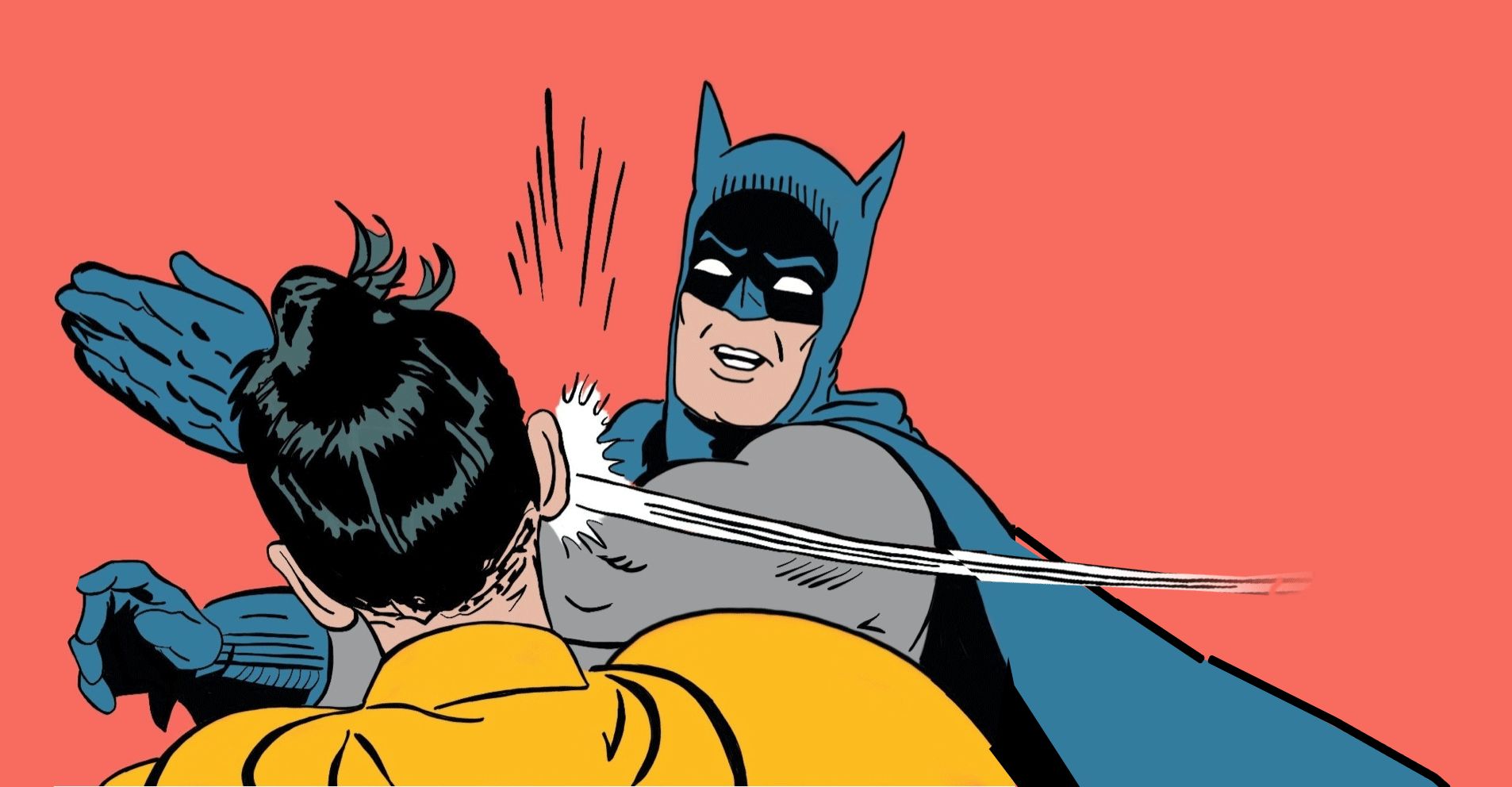
The panel is from World’s Finest Comics #153, published in 1965. The story is an “imaginary tale” — DC’s term for a non-canonical what-if — in which Batman becomes convinced that Superman is responsible for his father’s death, and pursues vengeance to the point of obsession.
In the panel, Robin urges him to let it go, and Batman strikes him.
The original dialogue is not what the meme uses. In the comic, Robin is the one begging Batman to abandon his vendetta, and Batman’s obsession is the problem. The meme discards all of that and keeps only the physical action: one character starting to speak, and another cutting him off with an open hand.
What it means / how it’s used
The format is a two-panel interruption template. Robin begins a statement; Batman slaps him before he can finish. The labels supply what was about to be said and who did not want to hear it.
Its uses:
- Cutting off a bad take before it can be completed.
- A community’s standard response to a recurring question.
- Refusing to hear an excuse.
- Self-implicating versions where the poster is being interrupted.
Its defining feature is timing. Unlike disagreement formats, this one is about not letting the statement finish — the objection arrives before the argument does, which is a specific and very online behaviour.
How it spread
The earliest known parody is from June 10, 2008, on an imageboard: Robin asks what Batman’s parents are getting him for Christmas, and Batman’s reply — a howled insistence that his parents are dead — became the format’s founding joke and its long-running alternate name.
It scaled through the early meme-generator era. A version on eBaum’s World in September 2008 took 107,000+ views; a dedicated Batman comic macro generator launched on November 22, 2009; a Facebook page followed in February 2010; and by April 2012 a Quickmeme page had accumulated 20,000+ user submissions in eight months.
That trajectory — imageboard, humour site, dedicated generator, mass submission — is the standard path for formats of that era, and it is why the template reached ubiquity years before most modern memes could.
Notable examples & variations
- The “my parents are dead” Christmas version, the founding joke.
- Two-label interruption versions, the modern standard.
- Multi-panel extensions with repeated slaps.
- Redrawn and colourised versions.
- Edits substituting other characters into the panel.
Legacy / cultural impact
Batman Slapping Robin is one of the oldest meme templates still in constant use, drawn from a comic published sixty years ago and in circulation online for nearly twenty.
Its survival is a function of how completely the image communicates its own grammar. A person mid-sentence and a hand arriving is legible without any cultural knowledge whatsoever — you do not need to know Batman, the comic, or the story to understand exactly what is happening and why it is funny.
Examples & gallery
Frequently asked
What comic is Batman Slapping Robin from?
World's Finest Comics #153, published in 1965 — an "imaginary tale" in which Batman wrongly believes Superman caused his father's death.
What is the original dialogue?
Not what the meme uses. In the comic Robin is begging Batman to abandon his vendetta; the meme keeps only the physical action.
Where does "my parents are dead" come from?
An imageboard parody from June 10, 2008 in which Robin asks what Batman's parents are getting him for Christmas. It became the format's founding joke and alternate name.
Why has it lasted so long?
The image communicates its own grammar — a person mid-sentence and a hand arriving is legible without knowing Batman, the comic, or the story.
Sources
Embed this meme
Drop this on your site — it links back here.