Harlem Shake
Origin
The track is “Harlem Shake” by the American producer Baauer (Harry Rodrigues), uploaded to YouTube on August 23, 2012 and released through Diplo’s Mad Decent label. It samples a 2001 line from the group Plastic Little — “do the Harlem shake” — over a slow, heavy trap build that drops abruptly about fifteen seconds in.
That drop is the entire format. On January 30, 2013, the video blogger Filthy Frank uploaded a clip of four people in latex suits dancing to it, and in early February 2013 two further uploads established the rules that everyone would follow:
- One masked person dances alone while everyone around them ignores them.
- The bass drops.
- Cut to the entire room in costume, in chaos.
What it means / how it’s used
The Harlem Shake was a participation format, not a joke. Its appeal was structural: the shot required no skill, no editing beyond one cut, and no more than thirty seconds of footage. Anyone with a phone, a room and a group of people could make one.
The comedy came from the contrast — the more mundane and orderly the first half, the funnier the second. Offices, classrooms, cockpits, operating theatres, and military units all produced versions built on exactly that gap.
How it spread
The scale was extraordinary and very brief. An office version uploaded on February 7, 2013 took more than 7.4 million views in its first week. By February 13, 2013, roughly 4,000 Harlem Shake videos were being uploaded to YouTube every day, with tens of millions of views accumulating daily.
Its chart impact was historic. Billboard had just revised its Hot 100 methodology to incorporate YouTube streaming data, and “Harlem Shake” — a track almost nobody was buying but everybody was watching — went to number one on the Billboard Hot 100, where it stayed for five weeks. It is the clearest single demonstration of how streaming changed what a hit record was.
The trend collapsed almost as fast as it rose. By March 2013 it was effectively over, having burned through every available setting in about six weeks.
The criticism
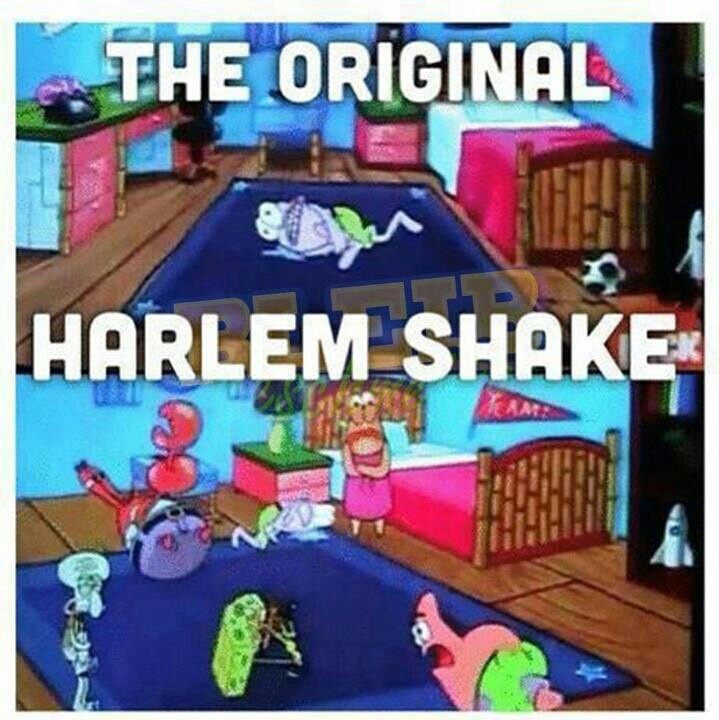
The format drew sustained objection from Harlem itself. The actual Harlem Shake is a real dance that originated in the neighbourhood around 1981 and has nothing to do with the meme — no masks, no costumes, and a specific shoulder movement the videos do not attempt.
Video responses from Harlem residents, and press coverage of them, pointed out that a global trend had taken the name of a Black neighbourhood’s dance and attached it to something entirely unrelated. The criticism did not stop the trend, but it is a documented part of its history.
Notable examples & variations
- Office and classroom versions, the format’s bulk.
- Institutional versions from universities, sports teams, and military units.
- Underwater, zero-gravity, and other novelty-setting versions.
- Brand and celebrity attempts, generally the weakest.
- Harlem residents’ response videos explaining the real dance.
Legacy / cultural impact
The Harlem Shake is the archetypal flash-in-the-pan participation meme: total global saturation followed by near-total disappearance, all inside two months.
Its lasting significance is on the charts rather than the culture. It was the first meme to demonstrate that a video trend alone could produce a number-one record, which permanently changed how labels approached virality — a direct ancestor of the modern practice of engineering songs for short-form video.
Examples & gallery
Frequently asked
Who made the Harlem Shake song?
Producer Baauer (Harry Rodrigues), uploaded to YouTube on August 23, 2012 and released through Mad Decent. It samples a 2001 line from Plastic Little.
What is the video formula?
One masked person dances alone while everyone ignores them; the bass drops; the whole room appears in costume, in chaos.
How big did it get?
By February 13, 2013 around 4,000 videos were being uploaded to YouTube daily. The song went to number one on the Billboard Hot 100 for five weeks after the chart began counting YouTube streams.
Is it the real Harlem Shake?
No. The actual Harlem Shake is a dance that originated in Harlem around 1981 and bears no resemblance to the meme. Harlem residents made response videos objecting to the name being used this way.
Sources
Embed this meme
Drop this on your site — it links back here.