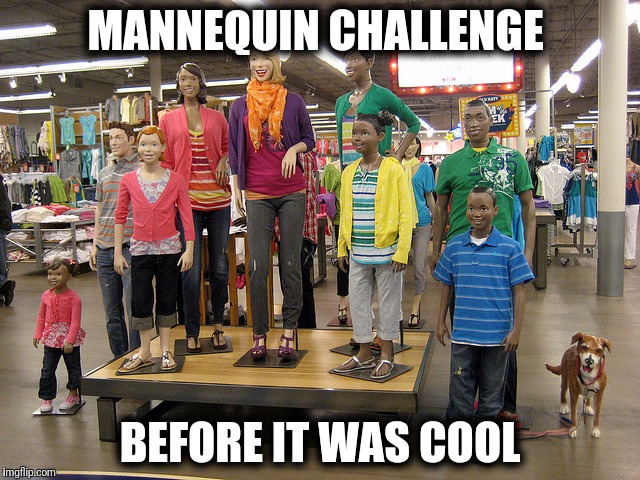
Mannequin Challenge
Origin
The Mannequin Challenge started in a high school. On October 26, 2016, a Twitter user posted a video of students at Edward H. White High School in Jacksonville, Florida, standing completely frozen mid-action while a phone camera moved through the room. The tweet took more than 4,400 retweets and 4,100 likes within a week.
The format is simple and demanding: everyone in the scene holds a pose — mid-step, mid-drink, mid-conversation — while a single continuous shot glides past them. The illusion only works if nobody moves, which makes each video a small feat of group coordination.
Almost every version used the same soundtrack: “Black Beatles” by Rae Sremmurd, a 2016 track whose slow, floating production suited the drifting camera perfectly.
What it means / how it’s used
The challenge is a participation format rather than a joke. Its appeal is threefold:
- Coordination — the larger the group, the more impressive the freeze.
- Staging — the best versions arrange elaborate tableaux with visual gags hidden throughout.
- Camera work — a good version is really a continuous-take short film.
Unlike most viral challenges, it required no equipment, no risk, and no skill beyond standing still, which is why it spread through schools, offices, and sports teams with unusual speed.
How it spread
The trend went from a Florida classroom to global saturation in roughly a week. By November 2, 2016 the hashtag was everywhere among school and college students, and major sports and news coverage arrived by November 4, 2016.
The participant list became a snapshot of late-2016 public life: Rae Sremmurd performed one during a Denver concert on November 3; Paul McCartney posted a version on November 10 that took over 86,000 retweets; the Cleveland Cavaliers filmed one with LeBron James and Michelle Obama at the White House; and Hillary Clinton and her campaign staff filmed one aboard their plane days before the 2016 US election.
The trend peaked in mid-November 2016 and faded quickly afterward, as participation formats reliably do once the largest possible participants have taken part.
An unexpected afterlife
The videos turned out to be scientifically useful. In 2019, Google AI researchers used a dataset of roughly 2,000 Mannequin Challenge videos to train neural networks to estimate depth in 3D space — because the videos provide something otherwise very hard to obtain: a moving camera recording a completely static scene full of people.
A viral dance trend accidentally produced an ideal machine-learning training set.
Notable examples & variations
- School and college versions, the format’s origin and bulk.
- Professional sports team videos, often elaborately staged.
- Celebrity and political versions from late 2016.
- Versions with hidden jokes revealed as the camera passes.
- Later revivals, which have never matched the original wave.
Legacy / cultural impact
The Mannequin Challenge is one of the defining internet moments of 2016, and among the last great pre-TikTok participation trends — spread through Twitter, Instagram, and Facebook rather than an algorithmic video feed.
Its research afterlife is the more durable legacy. Long after the videos stopped being made, the dataset they created continues to inform computer-vision work on depth perception — an unusually concrete outcome for a trend that consisted of people standing very still to a rap song.
Examples & gallery
Frequently asked
How did the Mannequin Challenge start?
A Twitter video posted on October 26, 2016 showing students at Edward H. White High School in Jacksonville, Florida frozen mid-action. It took 4,400+ retweets in a week.
What song was used?
"Black Beatles" by Rae Sremmurd, whose slow production suited the drifting camera. The duo filmed their own version at a Denver concert on November 3, 2016.
Who took part?
Paul McCartney, whose version took 86,000+ retweets; the Cleveland Cavaliers with LeBron James and Michelle Obama; Hillary Clinton's campaign staff; and countless school and sports teams.
Did the videos have any other use?
Yes. In 2019 Google AI researchers used around 2,000 Mannequin Challenge videos to train neural networks on 3D depth perception, since they show a moving camera recording a completely static scene.
Sources
Embed this meme
Drop this on your site — it links back here.