Ratatouille the Musical
Origin
It started with a joke song. On August 10, 2020, the TikTok user Emily Jacobsen uploaded a short, sincere original tune in praise of Remy, the rat from Pixar’s Ratatouille. It took over 1.1 million views across five months.
On October 19, 2020, the composer Daniel Mertzlufft produced a full orchestral arrangement of it — treating a TikTok joke as an eleven-o’clock number, complete with key change and choral finish. That version took 2.4 million views and 156,000 reactions in under a month, and made the premise explicit: what if this were a real musical?
The internet took the question literally.
What it means / how it’s used
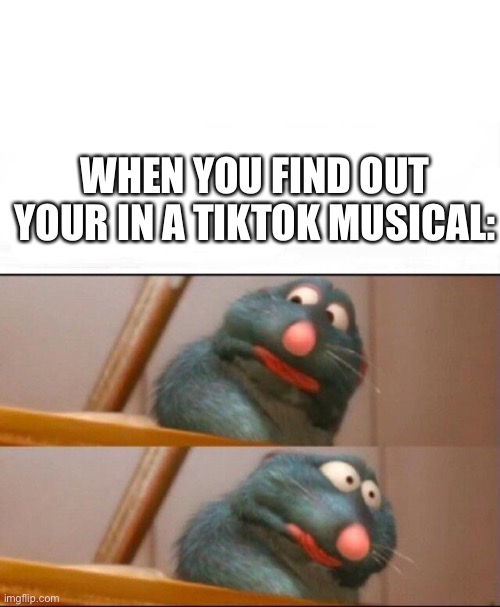
Ratatouille the Musical was not a meme format but a collaborative act of creation. On October 25, 2020, a dedicated account issued an open call for contributions, and thousands of people responded — writing songs, designing sets, choreographing numbers, drawing costumes, building playbills, and orchestrating each other’s work.
Nobody was coordinating it. Contributors picked unfilled roles — someone wrote Anton Ego’s number, someone else designed the lighting plot, someone else made the marketing — and the show assembled itself in public over about two months. By January 2021 the hashtag had 225.4 million views.
The remarkable thing is how much of the work was genuinely good. The songs were competently written musical theatre, not parody, and several of the contributors were working professionals.
How it became real
On December 9, 2020, Seaview Productions and TikTok announced an official one-night streaming production. It ran on January 1, 2021, tickets cost $5, and every contributor whose work was used was credited and paid.
The cast was genuinely starry: Tituss Burgess as Remy, Wayne Brady as Django, Adam Lambert as Emile, Ashley Park as Colette, Andrew Barth Feldman as Linguini, and André De Shields as Anton Ego.
It raised over $1 million for The Actors Fund — a charity supporting entertainment workers, at a moment when Broadway had been closed for nine months and the industry’s workforce was almost entirely out of work.
Disney did not object, publicly noting it was delighted by fan creativity. Reviews in The New York Times and The Washington Post were positive, and largely astonished.
Notable examples & variations
- Jacobsen’s original song and Mertzlufft’s arrangement.
- Individual contributor songs, several of which went viral independently.
- Fan-made set, costume and playbill designs.
- The January 1, 2021 benefit livestream.
- Later crowdsourced-musical attempts, none of which replicated it.
Legacy / cultural impact
Ratatouille the Musical is the high-water mark of collaborative internet creation — a complete piece of musical theatre, written by strangers who never met, produced professionally, and used to raise a million dollars for unemployed theatre workers.
Its timing was everything. It happened during a winter when theatre people had no work and a very large audience had nothing to do, and it channelled both into something that ended with money going to the right place. Several later attempts to engineer a similar phenomenon have failed, which suggests it was less a repeatable format than a specific moment finding its outlet.
Examples & gallery
Frequently asked
How did Ratatouille the Musical start?
TikTok user Emily Jacobsen posted a short original song about Remy on August 10, 2020, and composer Daniel Mertzlufft turned it into a full orchestral number that October.
Who wrote it?
Thousands of TikTok users, uncoordinated. Contributors picked unfilled roles — songs, sets, choreography, costumes, playbills — and the show assembled itself in public over about two months.
Did it actually get performed?
Yes. Seaview Productions staged a one-night streaming production on January 1, 2021, with Tituss Burgess, Wayne Brady, Adam Lambert, Ashley Park and André De Shields.
How much did it raise?
Over $1 million for The Actors Fund, at a point when Broadway had been closed for nine months.
Sources
Embed this meme
Drop this on your site — it links back here.