VSCO Girl
Origin
VSCO girl was a stereotype rather than a person — a composite of teenage-girl aesthetics assembled and mocked online through mid-to-late 2019. It took its name from VSCO, a photo-editing app launched in 2012 whose muted, film-like filters gave the look its visual signature.
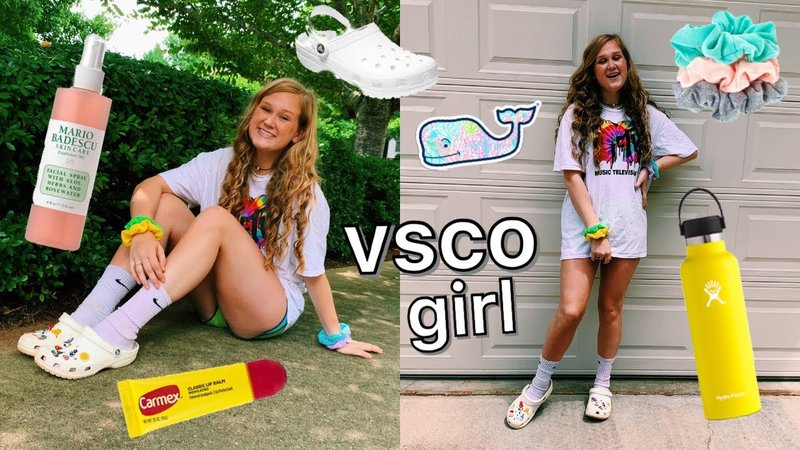
The uniform was extremely specific: an oversized T-shirt over shorts, scrunchies stacked on the wrist, a Hydro Flask covered in stickers, Birkenstocks or Crocs, Pura Vida bracelets, a Fjällräven Kånken backpack, and a metal straw for saving the turtles.
A guide published on i-D UK in late July 2019 is widely credited with crystallising the label, after which TikTok did the rest.
What it means / how it’s used
The meme was almost entirely parody. TikTok users performed exaggerated VSCO girls — aggressively offering scrunchies, shrieking “sksksksk,” interjecting “and I oop—,” and announcing environmental commitments while surrounded by consumer goods.
The two catchphrases have their own histories, and neither originated in 2019:
- “sksksksk” is a keyboard-smash expression of excitement with roots in African-American vernacular online, in use since at least 2014.
- “and I oop—” comes from a 2015 video by the drag performer Jasmine Masters, and spread widely on its own before being absorbed into the stereotype.
That borrowing is part of the story. Much of what was labelled “VSCO girl” language was Black internet slang adopted by a mostly white teenage aesthetic and then treated as native to it — a pattern that recurs constantly and was noted at the time.
How it spread
The trend peaked between August and October 2019, moving from TikTok parody into mainstream news coverage, Halloween costumes, and eventually retail marketing.
Its arc was compressed even by trend standards. It was named in July, ubiquitous by September, exhausted by November, and by 2020 the label was mainly used to date something as very 2019.
Its central tension was noted early: the aesthetic combined an environmental identity — save the turtles, reusable straws, reusable bottles — with a fairly demanding list of things to buy. That contradiction was the sharpest thing the parodies had to work with.
Notable examples & variations
- TikTok parody performances, the format’s main body.
- “sksksk and I oop” as a standalone catchphrase pairing.
- Halloween costumes assembled from the checklist.
- Brand attempts to market to the stereotype, generally poorly received.
- Retrospective posts using it as a 2019 time-stamp.
Legacy / cultural impact
VSCO girl is a useful case study in how quickly the internet can name, commodify and exhaust a subculture. The aesthetic existed before the label; the label made it legible, the legibility made it mockable, and the mockery killed it inside four months.
It also marked TikTok’s arrival as the platform that defines teenage identity trends. Every comparable aesthetic since — clean girl, coastal grandmother, mob wife — has followed the same compressed cycle, and VSCO girl was the first to run it end to end.
Examples & gallery
Frequently asked
What is a VSCO girl?
A 2019 teenage-aesthetic stereotype named after the VSCO photo app — oversized T-shirts, scrunchies, a sticker-covered Hydro Flask, Birkenstocks, Pura Vida bracelets and a metal straw.
Where do "sksksk" and "and I oop" come from?
Neither originated in 2019. "sksksksk" is a keyboard smash with roots in African-American vernacular online, in use since at least 2014; "and I oop—" comes from a 2015 video by drag performer Jasmine Masters.
When did it peak?
August to October 2019. It was named in July, ubiquitous by September, and largely exhausted by November.
What was the contradiction in it?
The aesthetic combined an environmental identity — save the turtles, reusable straws and bottles — with a fairly demanding shopping list, which is what most parodies targeted.
Sources
Embed this meme
Drop this on your site — it links back here.