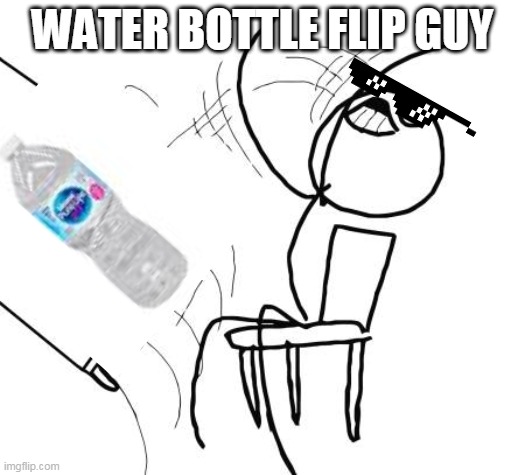
Water Bottle Flip
Origin
The trend began at a high school talent show. Mike Senatore, a student in Charlotte, North Carolina, walked on stage carrying a partly filled water bottle, flipped it once, and landed it upright on a table. The auditorium erupted.
Footage of the performance was posted to Twitter on May 24, 2016, and a YouTube reupload took over 5.6 million views within four months.
The physics is genuinely interesting, which is part of why it caught on. A bottle roughly one-third full works best: the water sloshes during the rotation, shifting the centre of mass and slowing the spin at exactly the point where the base is coming down. It is a real skill, learnable in an afternoon, and satisfying to land.
What it means / how it’s used
Bottle flipping was a participation trend rather than a joke format. Its appeal was that the barrier was effectively zero — a water bottle, a flat surface, and unlimited attempts.
That accessibility is also what made it a problem. Unlike most viral challenges, this one could be performed anywhere, silently, indefinitely, which meant it happened continuously in classrooms for most of a school year.
How it spread
The trend scaled through YouTube. Dude Perfect posted a compilation on July 18, 2016; a skateboarding-themed video on August 1, 2016 took 980,000+ views; and a montage on August 20, 2016 took 5.8 million views in a month.
By October 2016 it had reached mainstream news, with coverage from NBC, CNN, The New York Times and The Independent — much of it framed around the reaction of exhausted teachers and parents.
That reaction became part of the story. Schools around the world introduced bans, confiscated bottles, and in some cases prohibited them from classrooms entirely. It is one of a small number of internet trends to generate genuine institutional policy, alongside fidget spinners the following year.
Notable examples & variations
- The original talent-show clip.
- Trick-shot compilations from stunt channels.
- Increasingly absurd variants — long distances, moving targets, multiple bottles.
- Cap flips and other object substitutions.
- School-ban news coverage, a genre unto itself.
Legacy / cultural impact
Bottle flipping is a compact case study in a physical trend — one that spread through imitation in real rooms rather than through reposting. It required no phone to participate, only to document, which made it fundamentally different from the platform-native challenges that followed.
It also belongs to a specific mid-2010s moment, alongside the dab and the mannequin challenge, when internet trends were still primarily things people did in front of each other. Short-form video has since shifted almost all of that participation onto the platform itself.
The trend has had a quiet second life in education. Because the flip depends on a genuinely interesting interaction between angular momentum and a shifting centre of mass, physics teachers have used it as a classroom demonstration ever since — turning the thing that got bottles confiscated in 2016 into a lesson plan.
Examples & gallery
Frequently asked
How did bottle flipping start?
Mike Senatore, a high school student in Charlotte, North Carolina, landed a bottle flip at a talent show. Footage was posted to Twitter on May 24, 2016 and a reupload took 5.6 million views in four months.
Why does a bottle land upright?
A bottle roughly one-third full works best — the water shifts during rotation, moving the centre of mass and slowing the spin just as the base comes down.
Did schools really ban it?
Yes. Schools around the world confiscated bottles and prohibited flipping in classrooms, and the bans became a news genre of their own by October 2016.
Why did it spread so widely?
The barrier was zero — a bottle, a flat surface, and unlimited attempts — and it could be done anywhere, silently, indefinitely.
Sources
Embed this meme
Drop this on your site — it links back here.