Be Like Bill
Origin
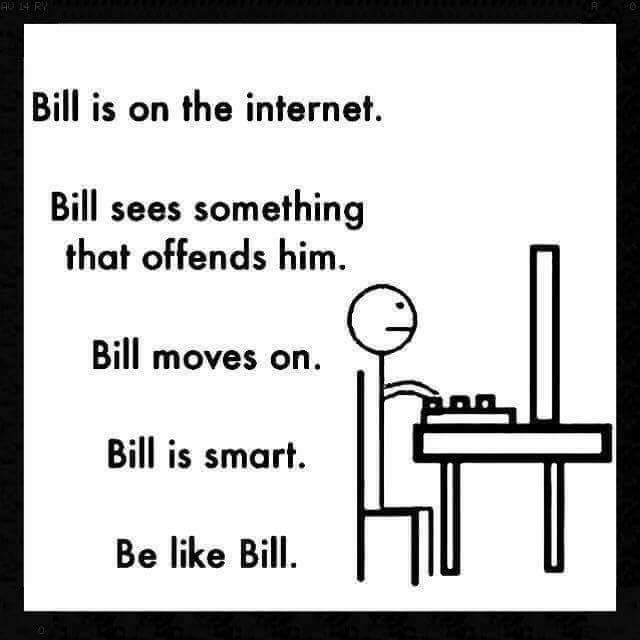
Be Like Bill is a stick-figure PSA. A crudely drawn man in a hat is described in short declarative sentences: Bill encounters a situation, Bill behaves sensibly, Bill does not do the annoying thing — and the strip closes with the instruction “Bill is smart. Be like Bill.”
The original creator is unknown. The format emerged on humour forums and Reddit around October 2015, initially framed as a jab at people the poster considered performatively outraged online.
It has clear precursors. A near-identical stick-figure PSA character circulated on a Russian humour site in March 2010, and public-transport etiquette posters — notably Queensland Rail’s 2011 campaign — used the same visual grammar.
What it means / how it’s used
The format delivers passive-aggressive advice disguised as a public-service announcement. Its structure is fixed:
- Bill encounters a common situation.
- Bill does the restrained, unobtrusive thing.
- The reader is instructed to be like Bill.
The advice is nearly always about not posting: Bill does not overshare, does not complain online, does not post spoilers, does not seek attention. The implied audience is somebody specific whom the poster is addressing without naming them.
That is precisely why it drew a backlash. The format’s entire mode is telling other people to be quieter, dressed up as friendly guidance.
How it spread
It went genuinely global in a matter of weeks, and it did so by localising. An Italian version launched on December 21, 2015 and took 226,000 likes within three weeks; a Spanish adaptation launched on January 2, 2016 and reached 405,000 followers in four days. Dozens of national variants followed, each with its own renamed protagonist.
That international spread is unusual, and it worked because the format is almost entirely text. There is nothing to translate but the sentences, and the stick figure is legible everywhere.
The backlash
By January 2016 the format had become sufficiently inescapable on Facebook that it triggered a substantial counter-reaction. Press coverage turned on it quickly, with The Washington Post publishing a piece explicitly instructing readers not to be like Bill and describing the meme as smarmy and passive-aggressive.
Parody versions followed immediately — strips in which Bill’s advice is terrible, or in which being like Bill is presented as a personality flaw — and the format’s own community produced most of them.
Notable examples & variations
- Sincere etiquette strips, the original form.
- Localised national versions with renamed characters.
- Parody strips where Bill’s advice is bad.
- Anti-Bill versions attacking the format directly.
- Later stick-figure PSA formats built on the same template.
Legacy / cultural impact
Be Like Bill is best remembered as a case study in meme backlash velocity. It went from novelty to saturation to widely derided in roughly three months, and its rejection was as coordinated as its spread.
It also marks a specific moment in Facebook’s history, when the platform’s sharing mechanics rewarded exactly this kind of content — short, moralising, endlessly localisable, and designed to be tagged at someone. Very little of that genre survived the platform’s subsequent changes, and Bill is one of the few pieces of it anyone still remembers.
Examples & gallery
Frequently asked
Who created Be Like Bill?
The original creator is unknown. The format emerged on humour forums and Reddit around October 2015, with clear precursors including a 2010 Russian stick-figure character and 2011 transport etiquette posters.
How does the format work?
A stick figure encounters a situation, behaves in a restrained and unobtrusive way, and the reader is told "Bill is smart. Be like Bill."
How did it spread so widely?
By localising. An Italian page took 226,000 likes in three weeks from December 2015, and a Spanish version reached 405,000 followers in four days. The format is almost entirely text, so it translated easily.
Why was there a backlash?
The format's mode is telling other people to be quieter, dressed as friendly advice. By January 2016 press coverage had turned on it, with The Washington Post calling it smarmy and passive-aggressive.
Sources
Embed this meme
Drop this on your site — it links back here.