Floating Boy Chasing Running Boy
Origin
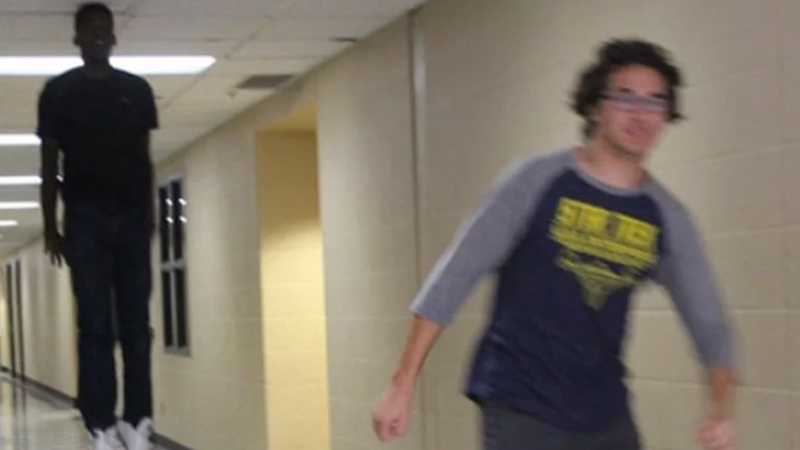
The photograph shows two boys outdoors. One is running. The other appears to be horizontal in mid-air, body flat, arms forward, apparently flying after him.
It is a trick of timing. The second boy is almost certainly mid-jump or mid-fall, caught at the exact moment his body is parallel to the ground — but the frame gives no visual cue to that, so he simply reads as levitating.
The photographer and original context are undocumented. Like a great many meme images, it arrived on the internet already detached from wherever it came from.
Its first known posting is from April 5, 2018, on a subreddit devoted to images that make you look twice.
What it means / how it’s used
The format is object-labeling for something you cannot outrun. The running boy is labelled with a person trying to escape; the floating boy with whatever is pursuing them.
Its uses:
- An obligation, deadline, or consequence that keeps pace no matter what.
- An intrusive thought or anxiety.
- A person, brand or institution that will not leave you alone.
- Absurd versions where the pursuer is trivial.
Its defining quality is effortlessness. The pursuer is not running — he is gliding, without visible exertion, which makes him considerably more unsettling than a chasing figure would be. That distinguishes it from other chase formats, where the pursuer is at least working.
How it spread
Adoption began three days after the first post. On April 8, 2018, an anonymous imageboard user framed the floating figure as an escaped anomaly from the SCP Foundation — a collaborative horror-fiction wiki — captioned as blocking your path, which established the “unstoppable entity” reading.
The object-labeling format took hold that summer. A July 18, 2018 Tumblr version applying it to a generational argument took over 113,000 notes in three months, and a September 26, 2018 version comparing a toothpaste brand to a dentist took 26,000+ points.
That range — internet horror fiction, generational politics, dental hygiene — within five months is a good indication of how flexible the composition is.
Notable examples & variations
- Two-label pursuit versions, the standard form.
- SCP and horror-fiction framings from the format’s early days.
- Versions where the floating boy is labelled as something benign.
- Multi-figure edits adding further pursuers.
- Straight reposts of the unedited photograph, still shared for the illusion.
Legacy / cultural impact
The image belongs to a productive genre: photographs that look impossible because of when the shutter fired. Nothing is edited, nothing is staged, and the strangeness is entirely a product of timing.
Those images make unusually good templates precisely because they are real. A composited flying figure would read as fake and lose its unease; a genuine photograph of a boy who happens to be horizontal keeps it.
Examples & gallery
Frequently asked
Is the floating boy photo edited?
There is no indication it is. He is almost certainly mid-jump or mid-fall, caught at the moment his body is parallel to the ground, with no visual cue to indicate that.
Who took the photo?
Unknown. The photographer and original context are undocumented — it arrived online already detached from its source.
How is the meme used?
As object-labeling for something you cannot outrun — the running boy is the person escaping, the floating boy is whatever pursues them effortlessly.
When did it become a template?
It first appeared on Reddit on April 5, 2018. The object-labeling format took hold that summer, with a July 2018 Tumblr version taking 113,000+ notes.
Sources
Embed this meme
Drop this on your site — it links back here.