Let's See Who This Really Is
Origin
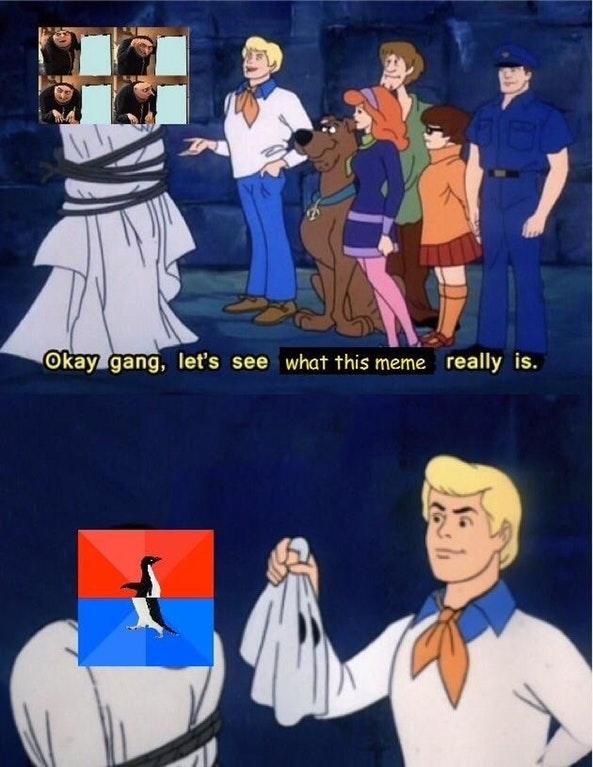
The unmasking is the signature beat of Scooby-Doo, Where Are You!, which premiered on CBS in 1969. The specific frame most often used comes from the episode “Hassle in the Castle,” which aired on September 27, 1969, in which the gang pulls the mask off a phantom and reveals Bluestone the Great, a washed-up magician.
The scene’s structure is a complete argument in two panels: a masked figure, then the ordinary person underneath. Every Scooby-Doo mystery ends this way, which is why the gesture is legible to people who have not watched the show in decades.
What it means / how it’s used
The format is an exploitable about hidden causes. The mask is labelled with a visible problem; the face underneath is labelled with what is really responsible. The joke is almost always that the “real” culprit is boring, obvious, or something the poster has been complaining about all along.
Common structures:
- A surface complaint unmasked as a systemic cause.
- A mysterious technical failure unmasked as a trivial mistake.
- A cultural trend unmasked as an older trend in new clothes.
- Self-implicating versions where the unmasked figure is the poster.
The format’s tone is accusatory but rarely angry. The gang’s expressions in the source frame are curious rather than furious, which keeps even pointed versions light.
How it spread
The exploitable took shape in mid-2017. On July 16, 2017, a Twitter user posted a multi-panel variation unmasking one video-game character as another, tying it to that era’s running “it’s just like Dark Souls” joke.
Reddit adoption followed. An October 11, 2017 post to r/dankmemes took over 4,300 upvotes at a 98% approval rate, and on April 18, 2018 a post to r/MemeEconomy cleared 8,800+ points within 24 hours — the point at which the format was formally recognised as a reusable template rather than a one-off.
Its longevity has been helped by meme generators adding it as a preset, which removes the editing barrier: the two-panel structure requires placing text in exactly two places.
Notable examples & variations
- The classic two-panel mask-and-face reveal.
- Multi-mask versions with several layers peeled back in sequence.
- Versions where the unmasking reveals the same thing that was already visible.
- Edits using other frames from the series’ many unmasking scenes.
- Live-action recreations and photo edits using the same composition.
Legacy / cultural impact
Scooby-Doo has run in some form continuously since 1969, and the unmasking is one of the most recognisable narrative devices in television — a formula so fixed that it became a cultural reference independent of the show.
The meme’s endurance reflects how useful its underlying claim is. The internet spends a great deal of time arguing that a visible problem is really a symptom of something else, and this format states that argument in a single image. It is one of the oldest source images still in heavy meme circulation, drawn from footage that is over fifty years old.
Examples & gallery
Frequently asked
What Scooby-Doo episode is the unmasking from?
"Hassle in the Castle," which aired September 27, 1969, in which the gang unmasks a phantom and reveals the magician Bluestone the Great.
How is the meme used?
The mask is labelled with a visible problem and the face underneath with what is really causing it — usually something boring or obvious.
When did the format take off?
It took shape in mid-2017, with an October 2017 r/dankmemes post taking 4,300+ upvotes and an April 2018 r/MemeEconomy post clearing 8,800 points in 24 hours.
Why is the unmasking so recognisable?
Every Scooby-Doo mystery ends the same way, so the gesture became a cultural reference independent of any single episode.
Sources
Embed this meme
Drop this on your site — it links back here.