Monkey Puppet
Origin
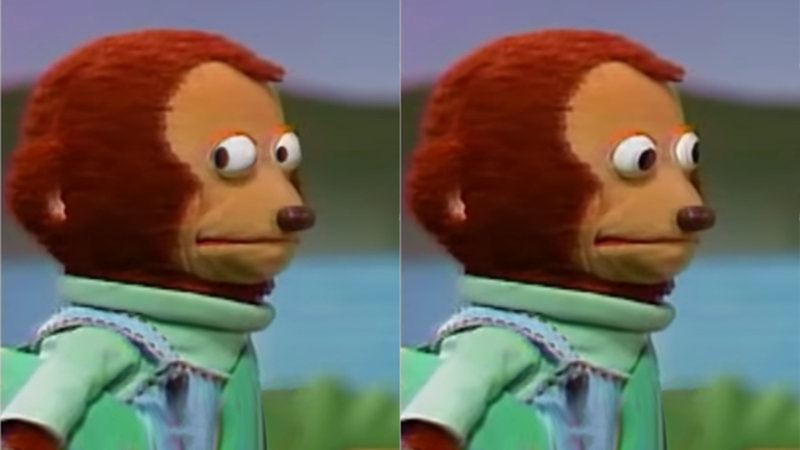
The face belongs to Kenta, a monkey puppet from the long-running Japanese educational children’s program Okiku Naru Ko (roughly, ‘Growing Children’). The now-iconic two-panel reaction, however, is not a raw screenshot — it was built. On May 5, 2016, a Peruvian musician and content creator named Daniel Flores (online as ‘Dani Flores’ or ‘Dani Villa’) Photoshopped the puppet’s eyes to make it glance warily to the side, then paired that doctored frame with one of Kenta facing forward. Flores wanted to depict the feeling of being caught sneaking a look at a crush; he later explained that simply turning the puppet’s head ‘was not enough to be funny — it was necessary for the character to return the view secretly.’ He first posted it in a Facebook group for his university in Lima, where it quickly gained hundreds of likes.
What it means / how it’s used
The paired frames read as a compact sequence: notice something, then pointedly look away. It is the perfect reaction to awkward, tense, or incriminating moments — a silent ‘I’m going to pretend I didn’t see that.’ The single side-glance frame is also used alone to react to an uncomfortable reply. The tone is sheepish and evasive, which is why it fits everything from a minor typo to a genuinely cringe revelation or a group chat going suddenly, awkwardly quiet.
How it spread
Flores’s edit spread first through Spanish-speaking Facebook and Twitter communities in the summer of 2016, then crossed into the English-speaking internet, where it became one of the most common reaction images of 2018-2019. Nicknamed ‘Pedro,’ ‘Awkward Look Monkey Puppet,’ or just ‘Awkward Monkey,’ it was catalogued on Know Your Meme and circulated worldwide across every major platform. By the end of the 2010s it was a fixture on Twitter, Reddit, and Facebook, frequently deployed in reply threads to quietly sidestep an awkward exchange, and it spawned localized captions in dozens of languages. Flores, who initially received little credit, was later interviewed as the true author of a meme that has been seen by hundreds of millions.
Notable examples & variations
- The side-glance frame used alone to react to an awkward comment.
- Both frames paired to show noticing, then ignoring, something.
- Captioned over incriminating situations (‘me pretending I didn’t send that text’).
- Reaction to a sudden, uncomfortable silence in a group chat.
Legacy / cultural impact
The Monkey Puppet is a case study in meme authorship: a static reaction built from a decades-old children’s puppet by one uncredited creator, spreading first across Latin America before conquering the global internet. Years later it remains a go-to shorthand for secondhand embarrassment and the universal urge to look away from something you wish you had not seen.
Examples & gallery
Frequently asked
Where is the monkey puppet meme from?
The puppet, Kenta, is from the Japanese children's show Okiku Naru Ko; the two-panel 'awkward' version was made by Peruvian creator Daniel Flores in 2016.
Who created the awkward monkey puppet meme?
Daniel Flores ('Dani Flores'), a musician from Peru, who Photoshopped the puppet's eyes to look sideways and posted it on May 5, 2016.
What does the meme mean?
It reacts to awkward, tense, or incriminating moments with a silent 'let's not talk about that,' looking away as if pretending not to notice.
What is the monkey puppet meme called?
It is known as the Awkward Look Monkey Puppet, Awkward Monkey, or 'Pedro.'
Sources
Embed this meme
Drop this on your site — it links back here.