Praise the Sun
Origin
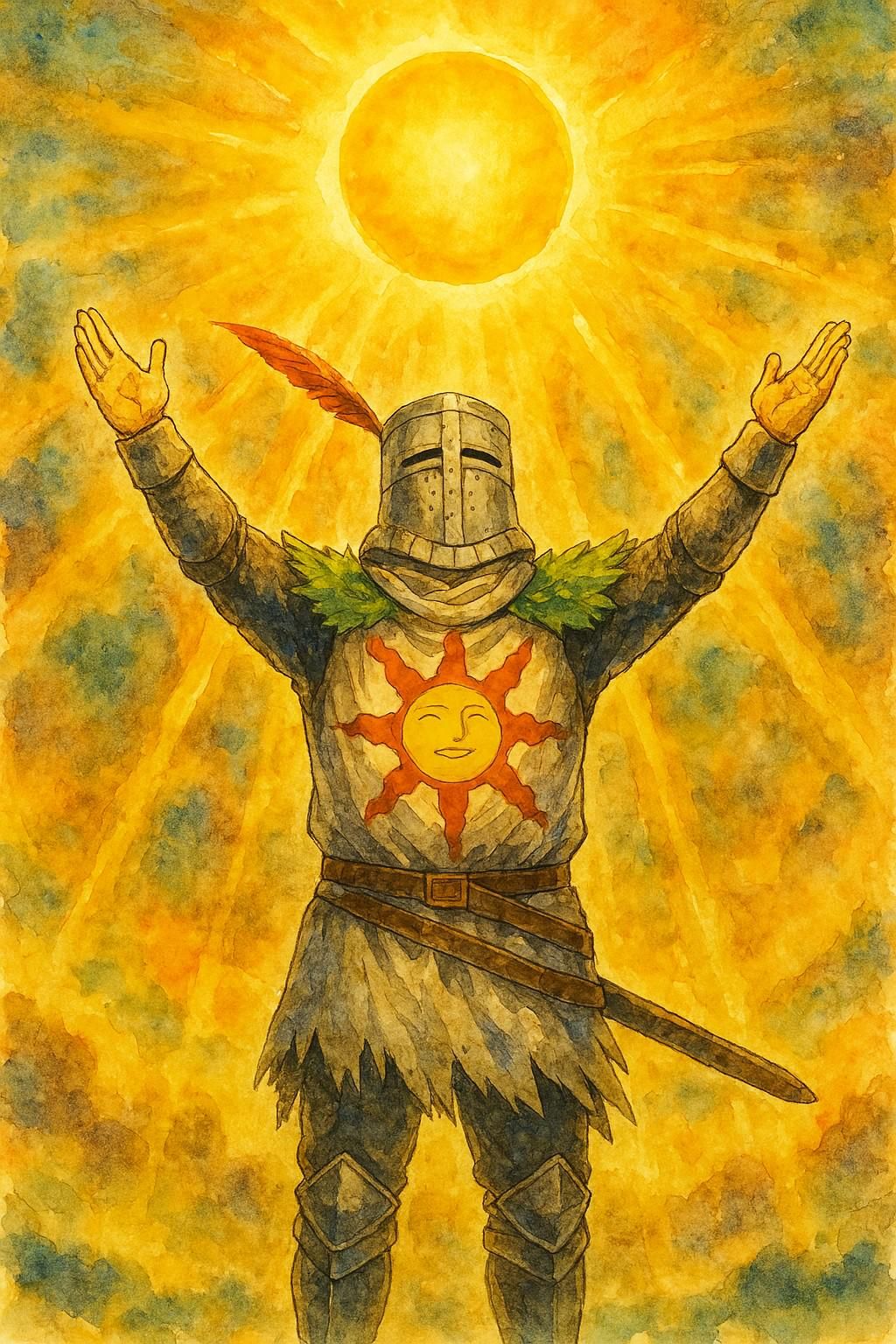
Dark Souls, developed by FromSoftware and directed by Hidetaka Miyazaki, launched on September 22, 2011. ‘Praise the Sun’ is inseparable from Solaire of Astora, a wandering knight in mismatched armor with a blazing sun painted across his tabard. Players meet him early, resting on a sunlit stretch of stonework, where he cheerfully invites them to ‘engage in jolly co-operation’ — his phrase for the game’s online summoning system, in which players cross into one another’s worlds to fight together. In a world built on isolation and cruelty, Solaire is the first genuinely warm character most players encounter. His signature emote, the ‘Praise the Sun’ gesture, has him rise onto his toes and thrust both arms overhead in a V, palms open to the sky; fans transcribe the pose in text as [T]/. The gesture even predates him, appearing as a rare holy gesture in FromSoftware’s earlier Demon’s Souls (2009).
What it means and how it is used
‘Praise the Sun’ is an all-purpose cry of joy, triumph, gratitude, and camaraderie, usually deployed when something finally goes right after hardship — surviving a brutal boss, being rescued by a summoned ally, or simply sharing a good moment. Its earnest, feel-good tone stands out sharply against the otherwise grim, sardonic Souls fandom, which is exactly why players embraced it. The arms-up pose and the [T]/ text art became shorthand for wholesome celebration well beyond the game itself.
How it spread
Solaire rapidly became the unofficial mascot of the Dark Souls community. On Reddit’s r/darksouls, forums, and image boards, players quoted ‘jolly cooperation’ and posted [T]/ to mark cooperative play, and cosplayers recreated his sun-emblazoned armor at conventions. The bit was reinforced in-game by the Warriors of Sunlight covenant, whose members summon each other for boss fights, cementing the sun as a symbol of teamwork. FromSoftware leaned into the affection: a ‘Praise the Sun’ gesture returned in Dark Souls III (2016), and Solaire cameos and references recur across the series. The phrase became well-known enough that Dictionary.com published a slang entry explaining it. Solaire’s own arc is quietly tragic — he wanders Lordran searching for ‘his very own sun,’ and attentive players can intervene to spare him a grim, hollowed fate, a bittersweet subplot that only deepened the community’s attachment to him.
Notable examples and variations
- The [T]/ text pose used to celebrate wins in chats, streams, and comment threads.
- Cosplay and fan art of Solaire mid-gesture, a fixture at gaming conventions.
- ‘Jolly cooperation’ adopted as a catch-all term for friendly multiplayer.
- In-game homages, including the returning Praise the Sun gesture in Dark Souls III.
Legacy
Solaire is routinely ranked among the most beloved NPCs in video game history, and ‘Praise the Sun’ outgrew Dark Souls to become a broader gaming expression of optimism and solidarity. More than a decade after the game’s release, the gesture remains a warm, recognizable emblem of a fandom otherwise known for punishing difficulty.
Examples & gallery
Frequently asked
Who says 'Praise the Sun' in Dark Souls?
It is associated with Solaire of Astora, a sun-worshipping knight in Dark Souls (2011) known for his optimism and his invitation to 'jolly co-operation.'
What does \[T]/ mean?
It is a text drawing of Solaire's arms-raised 'Praise the Sun' gesture, used to celebrate a win or signal wholesome cooperation.
What is 'jolly cooperation'?
It is Solaire's phrase for playing cooperatively online, taken from his line about summoning other players to fight alongside you.
Is Praise the Sun still used?
Yes. Years after Dark Souls launched, it remains a widely recognized gaming expression of triumph and camaraderie, and the gesture returned in later FromSoftware games.
Sources
Embed this meme
Drop this on your site — it links back here.