Spongebob Not Scared of The Flying Dutchman
Origin
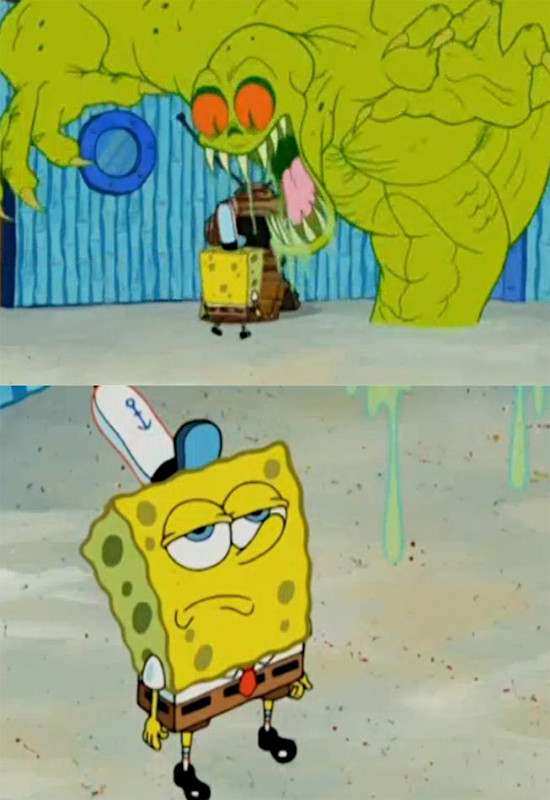
The scene is from the SpongeBob SquarePants episode “Ghost Host,” which premiered on May 5, 2006. The Flying Dutchman — the show’s recurring ghost pirate — is attempting to frighten SpongeBob by shapeshifting into progressively more horrifying forms.
SpongeBob is not frightened. He watches each transformation with a flat, faintly bored expression, entirely unmoved by an effort that is visibly exhausting the Dutchman.
The two-panel meme pairs the Dutchman at his most monstrous with SpongeBob’s complete indifference.
What it means / how it’s used
The format contrasts something designed to intimidate with someone who does not care. The top panel is labelled with the threat; the bottom with the person or group unbothered by it.
Common uses:
- A dramatic announcement meeting an indifferent audience.
- A warning or threat that carries no weight with its target.
- Spoilers, controversies, or discourse that a poster is opting out of.
- Marketing hype landing on people who are not the market.
Its particular value is that the indifference is not defiance. SpongeBob is not being brave; he is simply not engaged, which makes the format right for apathy rather than resistance — a much less well-served emotion.
How it spread
The two-panel format emerged on April 25, 2019, when a Reddit user posted a labelled version contrasting Avengers: Endgame spoilers with people who had no interest in the film. It took over 6,900 points at 92% upvoted within three months.
The template was formalised on May 14, 2019, when a version posted to a meme-economy subreddit took over 26,000 points at 93% upvoted in three months, and it spread across multiple communities over the following months.
Its origin in a spoiler joke is fitting. The format’s most natural use is opting out of a conversation everyone else is having, and it arrived at the height of one of the largest such conversations in recent memory.
The Dutchman panel also does more work than most “threat” images. Because he is visibly straining — shapeshifting through form after form and getting nothing back — the top panel carries its own note of futility, which makes the format read as this effort is wasted rather than simply I am not scared.
Notable examples & variations
- Spoiler and hype-cycle versions.
- Corporate or institutional warnings met with indifference.
- Fandom versions about discourse the poster is ignoring.
- Multi-panel versions with escalating threats.
- Crops of SpongeBob’s flat expression as a standalone reaction.
Legacy / cultural impact
SpongeBob SquarePants remains the single most productive source of reaction images on the internet, and its 2000s-era episodes in particular continue to yield new formats twenty years on.
This one persists because apathy is genuinely underrepresented in the reaction vocabulary. There are countless images for outrage, shock, and disagreement, and very few that communicate this is not aimed at me and I am not going to engage with it — which is, in practice, one of the most common online positions there is.
Examples & gallery
Frequently asked
What episode is this from?
The SpongeBob SquarePants episode "Ghost Host," which premiered May 5, 2006, in which the Flying Dutchman shapeshifts into horrifying forms and fails to frighten SpongeBob.
How is the format used?
The top panel is something designed to intimidate; the bottom is a person or group who simply does not care.
How is it different from other dismissal memes?
The indifference is not defiance. SpongeBob is not being brave — he is unengaged, which makes it right for apathy rather than resistance.
When did it become a meme?
April 25, 2019, with a version contrasting Avengers: Endgame spoilers with people uninterested in the film. The template was formalised on May 14, 2019 with a post taking 26,000+ points.
Sources
Embed this meme
Drop this on your site — it links back here.