Waiting for Dad
Origin
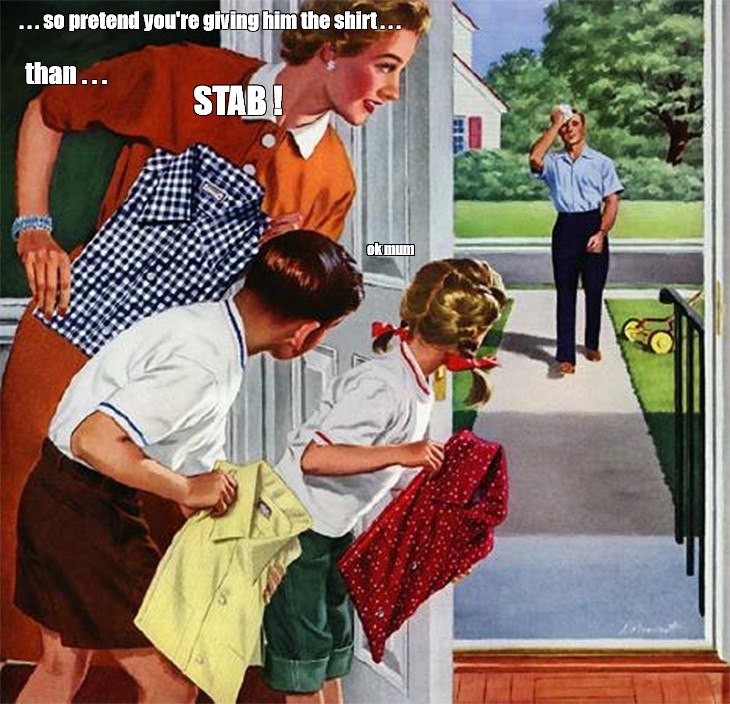
The source image is a 1954 advertisement. It ran in LIFE magazine on June 14, 1954, for Arrow Casual Wear, and shows a wholesome mid-century family gathered just inside the front door holding folded shirts, waiting to greet the father of the house on his return.
It is an entirely sincere piece of period advertising: warm lighting, neat clothing, everyone delighted.
The first known edit is from October 26, 2011, and it made one change — the folded shirts became knives. Nothing else was altered. The family’s expressions, posture and lighting remain exactly as the advertisement intended, which is what makes the edit work.
What it means / how it’s used
The format is an object-labeling ambush. The family is labelled with a group lying in wait; the door is the moment of arrival; the unseen father is whoever is about to walk into it.
Its uses:
- A community about to descend on someone who posted something unwise.
- A group waiting to spring a question, request, or obligation.
- Fandoms preparing for a new arrival.
- Self-implicating versions where the poster is the one about to be swarmed.
Its distinctive quality is anticipation rather than conflict. Nothing has happened yet in the image — everyone is simply waiting, cheerfully, and the target has no idea. That makes it right for jokes about being about to be ambushed rather than about the ambush itself.
How it spread
The knife edit circulated through Russian-language image communities from November 2011, where it was posted as a Photoshop template and attracted a run of community variations — an early instance of the format being treated as reusable rather than as a single joke.
It resurfaced and consolidated in 2018. A refined version was posted to Tumblr on June 29, 2018, reposted to a Facebook absurdist-meme group on July 10, 2018 where it took 1,900+ likes, and reached Reddit’s meme-economy community on July 23, 2018 with 2,100+ upvotes.
The seven-year gap between edit and adoption is unusually long, and the format’s spread across Russian, then Tumblr, then Facebook, then Reddit is a good map of how images migrate between essentially separate internets.
Notable examples & variations
- The original knife edit, still the canonical version.
- Object-labeled versions naming the waiting group.
- Edits substituting other objects for the shirts.
- Versions revealing what the father sees.
- Reposts of the unedited 1954 advertisement as a curiosity.
Legacy / cultural impact
The meme belongs to a productive genre: mid-century advertising recontextualised. Period ads are full of images that were designed to look wholesome and now read as faintly sinister, and the internet has spent two decades mining that gap.
This one is the cleanest example. The edit changes a single object and inverts the entire scene — the family is unchanged, the lighting is unchanged, and the warmth of the original is exactly what makes the new version unsettling.
Examples & gallery
Frequently asked
Where does the Waiting for Dad image come from?
A 1954 Arrow Casual Wear advertisement published in LIFE magazine on June 14, 1954, showing a family holding folded shirts to greet the returning father.
What was changed in the edit?
Only the shirts. The first known edit, from October 26, 2011, replaced them with knives and left everything else — expressions, posture, lighting — exactly as the advert intended.
How is the meme used?
As object-labeling for an ambush in progress — the family is a group lying in wait, and the unseen father is whoever is about to walk into it.
When did it become widely used?
2018, seven years after the first edit. Tumblr, Facebook and Reddit versions in June and July 2018 established it as a general template.
Sources
Embed this meme
Drop this on your site — it links back here.