You Guys Always Act Like You're Better Than Me
Origin
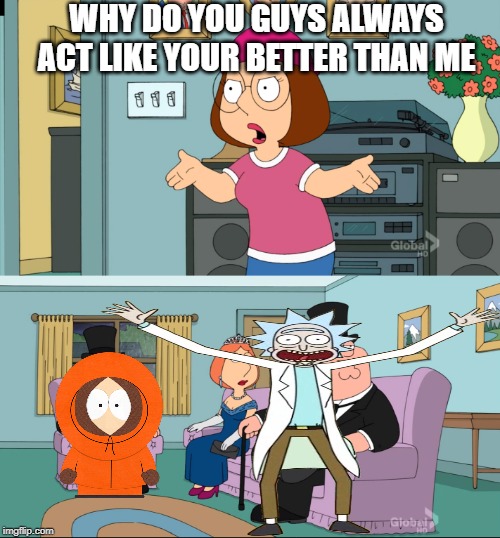
The still comes from the Family Guy episode “Seahorse Seashell Party,” which aired on Fox on October 2, 2011. In the scene, Meg Griffin — the family’s perpetual punching bag — finally turns on the rest of the household and tells them exactly what she thinks of them, opening with the line that everyone has looked down on her.
The episode is one of the show’s rare moments of genuine character reckoning. Stripped of that context, the frame becomes something simpler: a person confronting a group who have been treating her as beneath them.
What it means / how it’s used
The format is an object-labeling template about perceived inferiority. Meg is labelled as the overlooked or dismissed party; the family members are labelled as the things that supposedly outrank her.
Its most productive home has been fandom comparison — one franchise, series, or character cast as the one everybody condescends to, and the more celebrated ones cast as the family. It also serves:
- A less popular tool, platform, or product versus the dominant ones.
- A person’s neglected hobby versus their friends’ more respectable ones.
- Any group dynamic with a clear low-status member.
The template carries an unusual emotional charge for object-labeling. Meg’s expression is not comic — it is genuinely wounded — which makes the format work for jokes that are half-serious complaints.
How it spread
The meme was built inside an anime community rather than a general one. On October 23, 2018, a Redditor posted the labelled version to r/animemes, comparing two fanbases; it took over 1,200 upvotes in four months. Crucially, the same user posted the blank template in the comments, which is the single most important accelerant a format can have.
The template then compounded. A January 31, 2019 version took 4,200+ upvotes in eleven days; a February 3, 2019 repost to r/MemeEconomy flagged it as an emerging format; and on February 8, 2019, a version on r/dankmemes took 50,600+ upvotes in four days, moving it out of anime spaces and into the general meme economy.
Notable examples & variations
- Fandom versions casting one series as the disrespected sibling.
- Platform and software comparisons.
- Educational versions in subject-specific meme communities.
- Versions that place the poster as Meg in an entirely personal context.
- Edits adding or removing family members to change the group’s size.
Legacy / cultural impact
Family Guy has supplied the internet with a large number of reaction stills, and Meg specifically has become shorthand for being the designated target — a role the show has spent decades assigning her deliberately. The meme reads differently to viewers who know that history, which is part of why it lands.
The format remains in steady use in comparison-heavy communities. It also stands as a small case study in how formats spread: the original post was modest, but the creator publishing a blank template turned a single joke into an open tool, and the template outperformed the post that introduced it by a factor of forty.
Examples & gallery
Frequently asked
What Family Guy episode is the Meg image from?
"Seahorse Seashell Party," which aired on Fox on October 2, 2011, in which Meg finally confronts her family.
How is the meme used?
As an object-labeling template about perceived inferiority: Meg is the overlooked party and the family members are the things that supposedly outrank her.
Where did it start?
On r/animemes on October 23, 2018, comparing two anime fanbases. The creator also posted a blank template in the comments, which drove its spread.
When did it go mainstream?
February 8, 2019, when a version on r/dankmemes took 50,600+ upvotes in four days and carried the format beyond anime communities.
Sources
Embed this meme
Drop this on your site — it links back here.