Cursed Cat
Origin
The source photograph is real news photography. It was taken by Christopher Furlong and uploaded to Getty Images on November 12, 2008, showing a black cat crossing a road near police officers at a scene in Derby, United Kingdom.
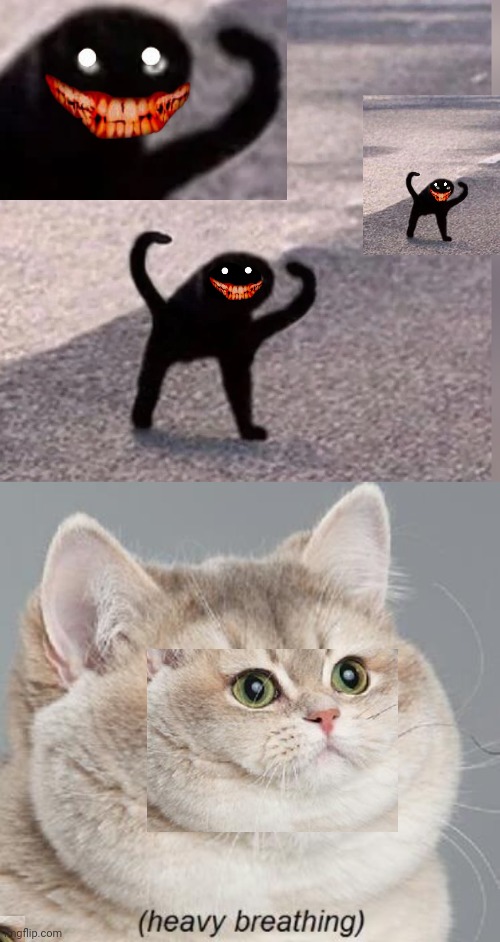
The meme is a heavy digital distortion of that cat. An unknown editor reworked the animal into a hunched, bipedal, furiously scowling creature — legs bunched, shoulders raised, face contorted into an expression of concentrated rage. The earliest documented posting of the distorted version is from Twitter on November 28, 2018, and it appeared in Facebook’s cursed-images community on December 1, 2018, taking over 420 likes.
What it means / how it’s used
Cursed Cat is a maximum-intensity anger reaction, deployed almost entirely for disproportionate rage at trivial things. The standard construction pairs a minor irritation with the image and a blunt declaration of fury.
It belongs to the cursed image genre — pictures that are disturbing through wrongness rather than content. The cat is not gory or frightening; it is simply distorted past what an animal’s body should do, and that wrongness is the joke. Its anger is funny precisely because the image itself is uncomfortable to look at.
Because the emotion is so exaggerated, it is rarely used for genuine anger. It is a way of performing outrage while making clear that the outrage is a bit.
How it spread
The meme’s early growth happened in Russian-language communities. From January 2019, the image circulated widely paired with a Russian caption, as part of a broader trend of deliberately distorted animal images.
It broke into English-language Reddit on March 13, 2019, when a recaptioned version took over 27,800 upvotes in two days. Variations then spread across multiple large subreddits through the spring, and the distorted cat became a standard reaction image for comic fury.
The cross-language path is notable. Cursed-image humour translates unusually well, because the discomfort is visual rather than verbal — no caption is required for the image to land, which lets it move between language communities faster than text-dependent formats.
Notable examples & variations
- The standard “minor inconvenience / extreme anger” macro.
- Russian-captioned versions from the meme’s early spread.
- Further-distorted edits pushing the deformation past the original.
- Multi-cat versions with several distorted animals reacting at once.
- Uses as a plain reply image with no text at all.
Legacy / cultural impact
Cursed Cat is among the most recognisable products of the cursed image era, a strand of internet humour that peaked in the late 2010s and shaped how images are edited for comic discomfort. Its aesthetic — deliberate distortion applied to an ordinary photograph — became a genre of its own.
There is also an incidental irony in its origin: a piece of professional news photography, taken at a genuinely serious scene, whose most-viewed descendant is a warped rodent-shaped cat used to express annoyance at slow Wi-Fi.
Examples & gallery
Frequently asked
Where does the Cursed Cat image come from?
A photograph by Christopher Furlong, uploaded to Getty Images on November 12, 2008, showing a black cat crossing a road near police in Derby, UK. The meme version is a heavy digital distortion of it.
How is it used?
As a maximum-intensity anger reaction, almost always for disproportionate rage at something trivial.
When did it become popular?
The distorted version appeared in late November 2018, spread in Russian-language communities from January 2019, and broke into English Reddit on March 13, 2019 with a post taking 27,800+ upvotes in two days.
What is a "cursed image"?
A picture that is unsettling through wrongness rather than graphic content. Cursed Cat is disturbing because the animal's body is distorted past what is possible, not because anything violent is shown.
Sources
Embed this meme
Drop this on your site — it links back here.