Maru
Origin
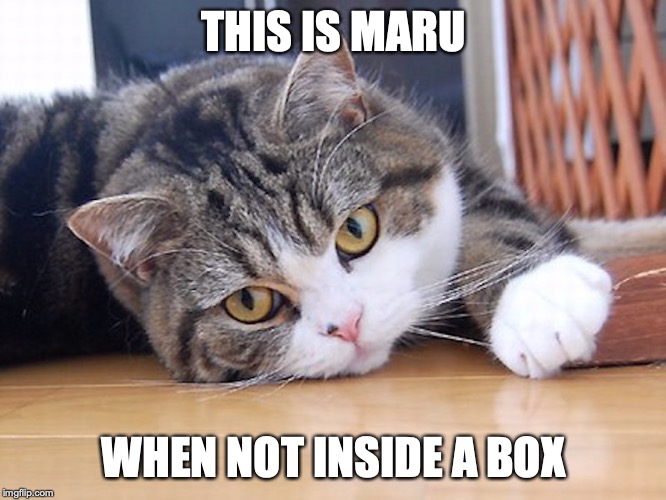
Maru was a male Scottish Fold cat who lived in Japan with an owner who posts online as mugumogu. The first video appeared on YouTube in 2008, and the channel — titled “I am Maru.” — went on to publish hundreds more over the following seventeen years.
Maru’s defining trait was a total, joyful commitment to boxes. He sprinted into them, skidded across floors to reach them, wedged himself into containers plainly too small for him, and reversed into ones that barely contained his head. The videos have no narration and no music beyond ambient household sound: just a cat, a box, and the inevitable collision.
What it means / how it’s used
Maru is less a joke format than a foundational figure of internet cat culture. He predates most of the animals people now think of as meme cats, and his popularity was built on repetition rather than a single viral moment — a decade and a half of short, quiet, near-identical videos.
His name functions as shorthand for a specific kind of content: calm, low-stakes, endlessly rewatchable animal footage with no attempt at a punchline. In an internet that increasingly optimised for shock and speed, mugumogu’s videos stayed exactly the same for seventeen years, and that consistency was the point.
He also gave cat owners a permanent reference for one of the species’ universal behaviours. “If I fits, I sits” and the entire cats-in-boxes genre owe much of their visibility to Maru.
How it spread
The channel grew steadily rather than explosively, accumulating an international audience through the late 2000s and 2010s. Its scale became formally documented in 2016, when Guinness World Records awarded Maru the title for most views for an animal on YouTube — 325,704,506 views as of September 22, 2016. He held the record until 2018, and videos featuring him have since been watched over 582 million times.
Maru’s success came without any of the usual accelerants. There was no merchandising push, no branded persona, and no attempt to build a character. The videos were short, unedited, and posted consistently, and the audience simply kept returning.
Maru died on September 6, 2025, aged 18, after being diagnosed with lung adenocarcinoma. The announcement was made on his own channel, and it prompted an unusual amount of coverage for an animal — including from Guinness World Records — reflecting how long he had been a fixture of the internet.
Notable examples & variations
- The “Box and Maru” series, the channel’s signature format.
- Videos of Maru attempting boxes clearly too small for him.
- Compilations of his skidding entries across hardwood floors.
- The “I am Maru” annual birthday videos.
- Later videos featuring Hana and Miri, the cats who joined the household.
Legacy / cultural impact
Maru is one of the small number of animals who defined what the internet is for in its early social-video era. He arrived before the algorithmic feed, before monetised pet influencers, and before the idea of an animal “brand,” and his channel remained recognisably the same thing throughout.
His seventeen-year run is also, in internet terms, extraordinary. Platforms, formats, and audiences turned over completely in that time. A Japanese cat running into a cardboard box did not.
Examples & gallery
Frequently asked
Who was Maru?
A male Scottish Fold cat who lived in Japan with an owner posting as mugumogu. His first YouTube video appeared in 2008, and he became famous for enthusiastically diving into cardboard boxes.
Did Maru hold a world record?
Yes. Guinness World Records recognised him for the most views for an animal on YouTube — 325,704,506 views as of September 22, 2016. He held the title until 2018.
How many views do his videos have?
Videos featuring Maru have been watched over 582 million times.
Is Maru still alive?
No. Maru died on September 6, 2025, aged 18, after being diagnosed with lung adenocarcinoma. The announcement was made on his own YouTube channel.
Sources
Embed this meme
Drop this on your site — it links back here.