Mocking SpongeBob
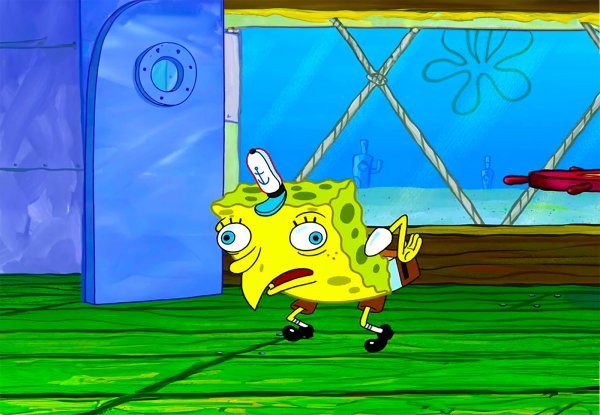
Origin
The image comes from the SpongeBob SquarePants episode ‘Little Yellow Book,’ a Season 9 installment that aired in 2013 (after originally being slated for late 2012). In it, Squidward secretly reads SpongeBob’s diary and learns that the mere sight of plaid sends SpongeBob into a hunched, strutting, chicken-like fit. That frame — SpongeBob mid-strut, arms bent, beak jutting — is the meme, and it needs no line of dialogue to read. The format broke out on May 4, 2017, when Twitter user @OGBEARD posted the screenshot with the caption ‘How I stare back at little kids when they stare for too long.’ The next day, May 5, 2017, user @lexysaeyang reposted it in a mockery context, and the format’s defining feature was born: pairing the image with text typed in rAnDoMlY aLtErNaTiNg caps.
What it means and how it is used
The alternating-caps styling visually imitates a taunting, sing-song voice — the schoolyard habit of repeating what someone just said in a mocking tone. The format typically runs in two parts: first a normal quote of a statement, then the chicken-posed SpongeBob captioned with the same words in ‘sPoNgEmOcK’ case. The effect is to ridicule an opinion or claim by echoing it back as childish nonsense. It works on bad takes, hypocritical statements, and — very often — the poster’s own past self. A typical post reads as a two-line call and response, the straight quote on top and the SpongeMock echo below.
How it spread
The meme dominated May 2017, with Google Trends showing searches for ‘Mocking SpongeBob’ spiking that month as it flooded Twitter, Reddit, and Instagram. Its two-part call-and-response structure made it endlessly reusable, and image generators quickly offered the template, turning it into one of the year’s most-used reaction images. Retrospectives regularly rank it among the defining memes of 2017, and even public figures and brand accounts adopted the mixed-case style to sound knowingly self-deprecating. Most consequentially, the alternating-caps device escaped the meme entirely: writing in mixed case became a standalone typographic convention for sarcasm online, understood even without the SpongeBob picture attached.
Notable examples and variations
- Quoting a bad opinion, then repeating it in aLtErNaTiNg cApS under the image.
- Self-deprecating versions mocking one’s own younger self.
- Political and sports takes echoed back in SpongeMock case.
- The mixed-case style used on its own as shorthand for sarcasm.
Legacy
Mocking SpongeBob became one of the defining sarcasm formats of the late 2010s and left a permanent mark on how people signal a mocking tone in text. Even as the specific image aged, the alternating-caps convention it popularized endured as a native feature of online writing. Alongside contemporaries like Evil Kermit and Roll Safe, it helped define the reaction-image golden age of that year.
Examples & gallery
Frequently asked
What is the Mocking SpongeBob meme?
It is a reaction image of SpongeBob in a hunched, chicken-like pose paired with text in aLtErNaTiNg caps, used to sarcastically mock a statement.
What episode is it from?
The frame is from the SpongeBob SquarePants episode 'Little Yellow Book' (Season 9, aired 2013), in which SpongeBob acts like a chicken whenever he sees plaid.
Why is the text written in random capitals?
The alternating caps imitate a taunting, sing-song voice, as if mimicking the person being mocked.
When did it go viral?
It broke out on Twitter in early May 2017 and dominated that month before the alternating-caps style spread as a general marker of sarcasm.
Sources
Embed this meme
Drop this on your site — it links back here.