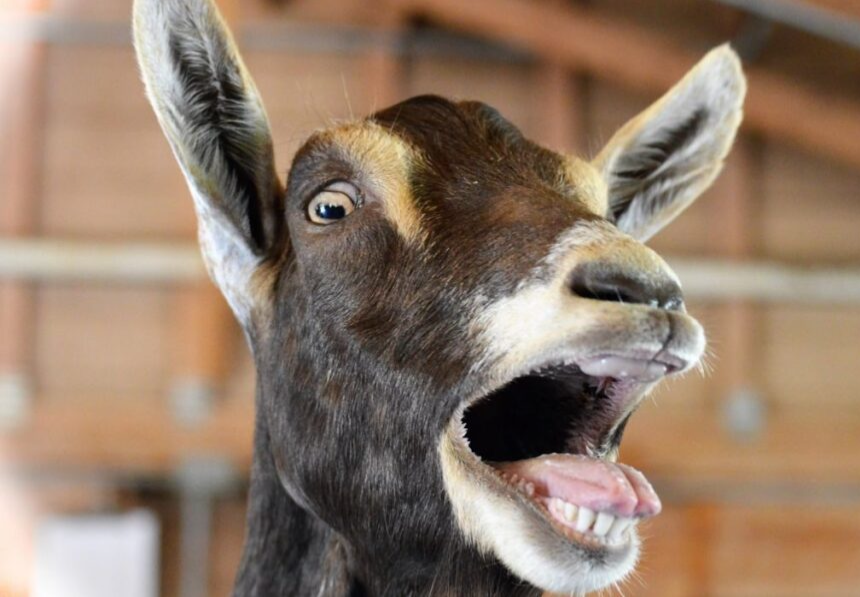
Screaming Goat
Origin
Goats really do sound like that. Certain breeds produce bleats in a register and cadence uncannily close to a human shout, and clips of individual goats screaming had circulated on YouTube for years as isolated curiosities.
The meme began when someone gathered them together. On February 7, 2013, the humour site The Roosevelts uploaded “Goats Yelling Like Humans — Super Cut Compilation,” a rapid-fire montage of the best examples. It went viral within weeks and has since accumulated more than 15 million views.
Two days later, the format that defined the trend appeared.
What it means / how it’s used
The joke is substitution: a goat’s scream is spliced into a piece of media where a human voice should be, and the incongruity does everything. There is no caption, no template, and no commentary — just an audio edit and a punchline that lands in about a second.
Its main forms:
- Pop songs with the vocal hook replaced by a goat.
- Dramatic film and television moments with a goat scream at the climax.
- Sports commentary and news clips interrupted.
- Compilations of the raw source clips, still widely watched.
How it spread
On February 9, 2013, a YouTuber uploaded a mash-up of Taylor Swift’s “I Knew You Were Trouble” with a screaming goat spliced into the chorus — replacing the song’s distinctive vocal drop with a bleat. It took more than 1.09 million views and 800 comments within three weeks, and later uploads of the same edit pushed well past 4.9 million views.
That single edit set off the trend. Through February and March 2013, dozens of derivative versions appeared, applying the same treatment to other pop songs, film trailers, and television moments. The joke was covered by TIME, SPIN, and E! within weeks, and for a few weeks in early 2013 the goat edit was one of the most reliable formats on YouTube.
The trend burned out quickly, as audio-substitution fads reliably do — but it has resurfaced periodically ever since, and the Taylor Swift version in particular is still shared on its anniversaries.
Notable examples & variations
- The Taylor Swift “I Knew You Were Trouble” edit, the definitive version.
- Dozens of other pop-song substitutions from the same 2013 wave.
- Dramatic-film versions where the goat replaces a scream.
- The original super-cut compilation, still widely viewed.
- Later revivals and anniversary reposts.
Legacy / cultural impact
The screaming goat trend is a good example of an early-2010s YouTube phenomenon: a joke made entirely from audio editing, requiring no template, no image, and no shared cultural reference beyond the source song.
It also permanently changed how the animal is perceived online. “Screaming goat” is now a recognised comic category — sold as a novelty toy, used as a sound effect, and deployed as shorthand for absurd interruption — and a substantial share of the internet’s mental image of goats dates to a three-week period in early 2013.
Examples & gallery
Frequently asked
Do goats really scream like that?
Yes. Certain breeds produce bleats in a register and cadence very close to a human shout, and the clips used in the meme are genuine.
Where did the meme start?
A compilation titled "Goats Yelling Like Humans — Super Cut Compilation," uploaded by the humour site The Roosevelts on February 7, 2013. It has since passed 15 million views.
What is the Taylor Swift goat version?
A February 9, 2013 mash-up splicing a screaming goat into the chorus of "I Knew You Were Trouble." It took over 1.09 million views in three weeks and later uploads passed 4.9 million.
How long did the trend last?
It peaked over February and March 2013 and burned out quickly, as audio-substitution fads do — though it resurfaces periodically, especially on anniversaries.
Sources
Embed this meme
Drop this on your site — it links back here.