Wait, I Thought It Was a Joke
Origin
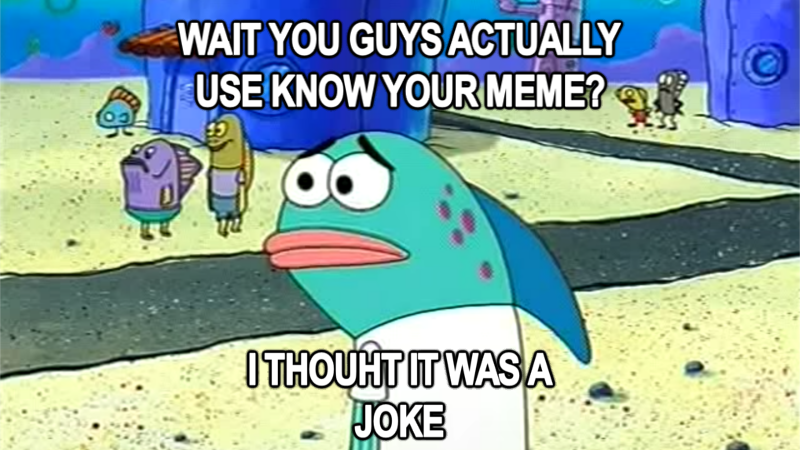
The image is a background character from SpongeBob SquarePants: a small, worried-looking blue fish who appears roughly eighteen seconds into the episode “The Bully,” which first aired on October 5, 2001. The fish has no lines of consequence and no name most viewers would know. What it has is an expression of dawning, anxious realization — eyes wide, mouth slightly open, the face of someone who has just understood something they would rather not have.
The meme pairs that face with a two-part caption: a shocked question, followed by the deflating admission “I thought it was a joke.”
What it means / how it’s used
The format captures a very specific and very online experience: discovering that a group you assumed was being ironic actually means it. The poster has been treating a community, an in-joke, or a running bit as satire, and has just realized the participants are sincere.
The structure is always the same. The top line is a startled question addressed to a group. The bottom line is the retreat — the poster explaining, mostly to themselves, that they had been reading the whole thing as a bit.
Beyond that core use, it works for any moment of misjudged register: assuming a hobby was a joke and finding out it is a serious pursuit, assuming a plan was hypothetical and learning it is happening tomorrow, assuming a claim was sarcasm and learning it was a statement of fact.
How it spread
The first widely circulated image macro was uploaded to iFunny on December 23, 2019, pairing the fish with a two-line caption about discovering a group’s stated views were genuine. It took over 440 smiles within a year — small numbers, but the template was fully formed.
The snowclone phase arrived in spring 2020. On April 21, 2020, a Reddit edit swapping the subject took 880+ upvotes; April 27 and 28, 2020 produced two widely shared Instagram variations; and on June 26, 2020, an Instagram version reframing the joke around age cleared 39,000+ likes. By mid-2020 the fish was a standard reaction image across Instagram, Reddit, and Twitter.
Its rise coincided with a broader moment of meme culture turning inward — a period when a great deal of online humor was about irony itself, and about the difficulty of telling sincerity from performance. This format names that problem directly.
Notable examples & variations
- Fandom versions where a joke theory turns out to be a genuinely held belief.
- Hobby versions about discovering a niche pursuit is taken very seriously.
- Workplace versions where a proposal floated as a joke gets scheduled.
- Text-only uses of “I thought it was a joke” as a reply, with no image.
- Edits that keep the fish but replace the caption entirely with a franchise-specific misunderstanding.
Legacy / cultural impact
SpongeBob SquarePants is the single most productive source of reaction images on the internet, and this is one of the clearest cases of a background character — not SpongeBob, not Patrick, not Squidward — becoming a standalone meme. The show’s habit of populating scenes with expressive, briefly visible fish gave the internet a deep library of faces with no narrative baggage attached.
The format’s continued use reflects how permanent its subject is. As long as online communities blur the line between sincerity and performance, there will be a use for a small blue fish quietly asking whether everyone was serious the entire time.
Examples & gallery
Frequently asked
What episode is the worried blue fish from?
The SpongeBob SquarePants episode "The Bully," which first aired October 5, 2001. The fish appears about eighteen seconds in.
What does the meme mean?
It captures the moment you realize a group you assumed was joking is actually sincere — or, more broadly, any misjudgment of sincerity versus irony.
When did it become a meme?
The first widely circulated version was uploaded to iFunny on December 23, 2019, and the format spread widely as a snowclone through spring 2020.
Why are SpongeBob background characters such common memes?
The show fills scenes with expressive, briefly visible fish who carry no narrative baggage, making their faces easy to repurpose as pure reactions.
Sources
Embed this meme
Drop this on your site — it links back here.