Well Yes, But Actually No
Origin
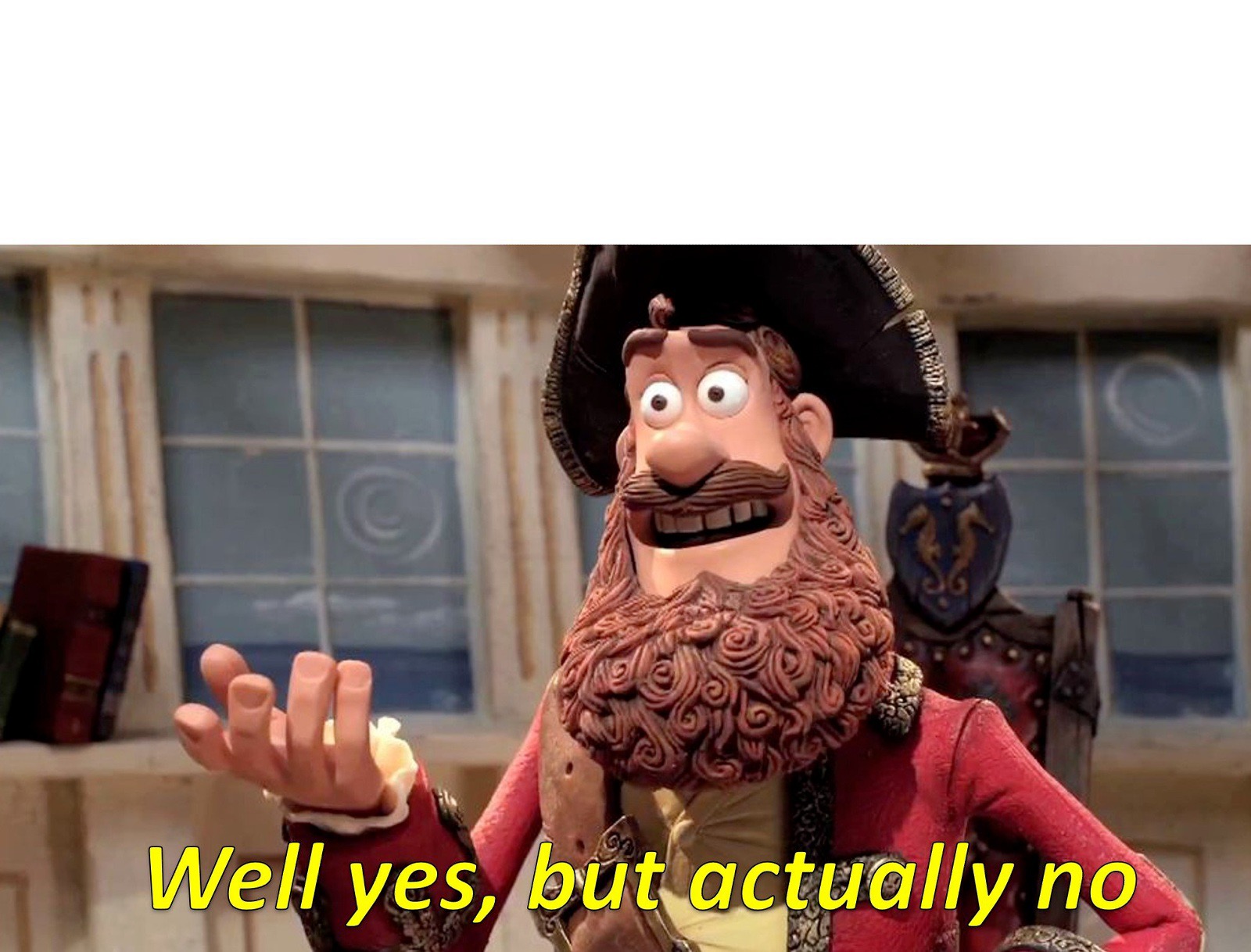
The image is a still of the Pirate Captain, the luxuriantly bearded hero of Aardman Animations’ stop-motion comedy “The Pirates! In an Adventure with Scientists!” — released in the United States as “The Pirates! Band of Misfits” (2012) — voiced by Hugh Grant in his first animated role. Crucially, the exact frame does not come from the feature film but from “So You Want to Be a Pirate!”, an 18-minute bonus short directed by Jay Grace and written by Gideon Defoe (author of the original Pirates! novels) that shipped with the film’s 2012 DVD and Blu-ray release. In the short, the Captain dispenses tongue-in-cheek pirating advice alongside his dodo, Polly, and when a question implies his beard grew so magnificent from all his shouting, he replies, “Good guess, but actually no.” Viewers widely mishear the line as “Well yes, but actually no,” and the captioned screenshot was born from that mondegreen rather than from any real line in the movie.
What it means / how it’s used
The phrase functions as a self-contained, good-humored refusal. It concedes the surface logic of a claim (“well yes…”) and then flatly rejects the conclusion (“…but actually no”), which makes it ideal for “technically correct but misleading” arguments, loaded questions, and any situation where the obvious answer is not the real one. The Captain’s cheerful, open-palmed shrug softens the “no” into something patient rather than hostile — a way to shut a topic down without starting a fight. Because the sentiment is universal and the image needs no translation, it reads the same in any language.
How it spread
The meme took off in February 2019. On February 13, 2019, a Redditor posted a captioned image macro of the scene to r/HistoryMemes, and within hours imitators appeared across other subreddits; an r/MemeEconomy post reportedly cleared over 23,000 upvotes in two days. From Reddit it jumped quickly to Twitter, Discord, and Facebook, where its polite-but-final tone made it a favorite one-line rebuttal in debates. The claymation texture — visible thumbprints in the clay, hand-painted eyes — gave the reaction a warmth that plain text could not match, helping it stand out from the era’s flatter reaction images.
Notable examples & variations
- Paired-panel edits that answer a loaded question with the Captain’s shrug.
- “Well no, but actually yes” inversions that flip the structure for the opposite effect.
- GIF versions that animate the original line for extra deadpan timing.
- Localized recaptions in dozens of languages, since the image carries the joke on its own.
Legacy / cultural impact
“Well yes, but actually no” endures because it fills a precise rhetorical niche — the qualified refusal — that older reaction images never quite covered. It also sent a fresh wave of attention back to Aardman’s commercially underappreciated “Pirates!” films, whose theatrical run never approached the fame of Wallace and Gromit, proving a throwaway line from a bonus short could outlive the movie that produced it.
Examples & gallery
Frequently asked
Where is the "Well yes, but actually no" image from?
It is a still of the Pirate Captain (voiced by Hugh Grant) from Aardman's short "So You Want to Be a Pirate!", a 2012 bonus feature packaged with the film "The Pirates! Band of Misfits."
Is "well yes, but actually no" a real line of dialogue?
Not exactly. In the short the Captain actually says "Good guess, but actually no," which fans commonly mishear as "Well yes, but actually no."
What does the meme mean?
It is a polite but firm refusal that concedes a point's surface logic before rejecting it — perfect for "technically correct" or loaded arguments.
When did it go viral?
In February 2019, after a captioned version hit Reddit's r/HistoryMemes and quickly spread to Twitter, Discord, and Facebook.
Sources
Embed this meme
Drop this on your site — it links back here.